Quantcast

Saturday, 6 April 2013

Arzak revisited 29.3.13

We came, we ate, we raved about Arzak. Four years on and we returned.

This time the dishes were very different. The trademark egg course remained, but the style of the cuisine seemed to have moved on. A touch of Danish/Noma influence perhaps? Overall I'm not sure if it's a case of gastronomic nostalgia always winning out, but we felt our first visit had greater momentous impact.

We sat at the Chef's Table this time, under rainbow shards of coloured glass and facing the brightly lit main pass. Elena and her father Juan Mari Arzak both came to say 'hello' but were otherwise rarely seen, leaving explanations of each course in the hands of a waitress whose heavily accented English was often difficult to understand.

The language barrier weighed heavily on my appreciation of dinner, as it was often impossible to understand exactly what we were eating nor to appreciate the flavours and technical skills woven into each dish. While some dishes stood alone in being delicious, others were lost on us.

On my first visit to Arzak the dishes seemed complicated at first, with foams and pastes and other forms of kitchen wizardry very much in evidence. But in fact simplicity won out as the tastes and compositions were classic, easy to understand and often locally inspired. We could relate to what was on our plates. This key aspect of our dining experience was sadly missing this time.

Dinner was still enjoyable, certainly, but disappointingly not the tongue tingling sensation I remembered from my first experience. Perhaps three time's a charm?


Beans, bacon and chestnut. I tasted black beans and the thin crisp of iberico fat floating on top. Chestnuts added a subtle sweetness.
Anchovy and strawberry. Served on a slick of fruity balsamic flavoured something. Fragrant, salty sweet and delicious.
Red codfish. On a spiral of crisp pastry, with onion seeds I think? Some kind of emulsified sauce. Salty fish really. With crispy bits.
Kabrarroka pudding with kataifi. Local fish mousse wrapped in fine kataifi hairs and deep fried. 
Chorizo with tonic. A purée of chorizo wrapped in a thin slice of mango and bathed in tonic water. Rather recycled presentation, but a lovely little mouthful.
Cromlech, manioc and huitlacoche. Y'What? Okay a cromlech is apparently Welsh for a megalithic or large stone structure. Manioc is better known as cassava, which formed the casing of our mini megalith and was apparently 'hydrated with huitlacoche', a corn fungus used in Mexican cuisine that has a smoky, earthy flavour. Having never tasted this before I couldn't identify it. I did taste the strands of sweet caramalised onions inside the cassava casing and the smooth foie gras paste, but none of the green tea mentioned on the menu. 
Hemp, mustard and lobster. With crisp hemp bread and mustard vinaigrette. Lovely lobes of butter poached lobster, paired with sorrel leaves hiding an English mustard emulsion, crunchy hemp seeds baked into a sweet salty crisp and lobster stock clothes pegs. We weren't sure about the relevance of the latter! The dish also came with a refreshing little salad of micro leaves with tapioca pearls, hemp seeds and pink slices of grapefruit.
Oysters with a sea crust. The alternative to lobster. These were browned on one side giving them a half cooked texture and served with paprika fronds. The whole effect was rather too salty.
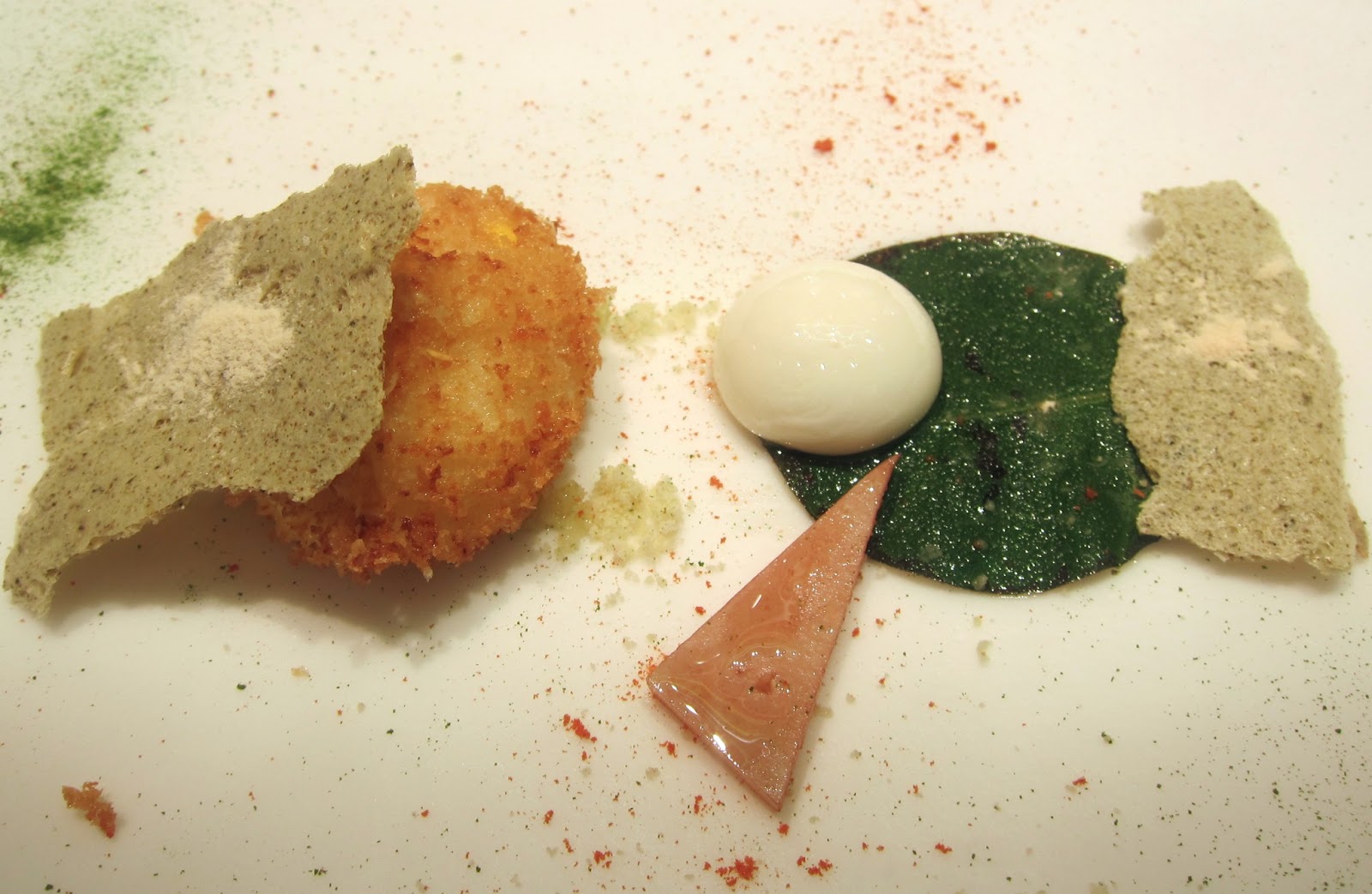
Ovo-lacto. Egg with a semi crispy shell and baobab, served with lactic leaves and curds. Again y'what? So as far as we could decipher, the egg was low temperature poached and coated in breadcrumbs. The greyish crisps were dehydrated milk, served with a bubble of liquid gorgonzola, a slice of idiazabal cheese marinated in port and an 'oca de lada' leaf. There was no trasnlation for the latter, sourced from Koppert Cress, who import the leaf from Thailand under their own brand name. According to Arzak with was to prevent anyone from identifying it. Stranger and stranger.
Monkfish green witch. Or monkfish served in a green balloon.
Following removal of the rice cracker balloon. The monkfish was beautifully cooked - soft and juicy, meaty without any rubbery bounce. Served with cloves of confit garlic and a parsley seaweed sauce.

Alternatively, there was white sole served white seaweed and a green sea vegetable sauce. The firm and flavourful sole fillets became the highlight of dinner for those who had it.
The Kobe's beer. Another hard to understand wordplay description. What looked like a large lollipop or a cutlet of some sort turned out to be a patty of minced Kobe beef, sourced locally from the first generation of Wagyu cattle bred from a herd imported from Japan. It was cooked medium rare and served with a liquorice bark 'bone', beetroot onions, pomegranate seeds, parmesan crisp and a mildly bitter beer sauce. I found the minced meat to be tender and tasty, but nothing extraordinary. It surprised me to find that the main dish was effectively a burger filling.
Served alongside the Kobe beef, a dish of sweet leek cake and deep fried leaves. Again, nice but not really much of note. 
Playing marbles with chocolate. Chocolate marbles with amaranth and oregano sauce. The chocolate balls contained liquid in their centres. I have always liked puffed amaranth, which looks like tiny baby pieces of popcorn, but the chocolate tasted a bit strange, I suppose this was the oregano influence.
The alternative to chocolate marbles - Roots, fruits and seeds. A thin layer of white chocolate flavoured with parsley filled with black chocolate emulsified with kuzu (a starch used by the Japanese as a thickener) and lime flavour, served with Frangelico and Aperol balls.
Golden footprint and ladybird. Caramalised fruits served under black sesame bread (the footprint), pepper and liquorice ladybird filled with vanilla yoghurt pannacotta and olive oil cristal. Caramel crumbs. Served alongside was an Indian gooseberry ice cream.
The alternative to the ladybird dish - Black apple. Sautéed apple finished with an aspect of truffle and apricot. Served alongside a basil sorbet with sweet seeds.
Cinnamon curls
Chocolate ironmongery petit fours.

Tuesday, 26 March 2013

Hot and numbing chicken slices


This recipe is from Fuchsia Dunlop's Sichuan Cookery. It is probably the one dish from all of her books that I have made the most often over the years. It is so easy to make and yields deliciously addictive results every time.

You can use it to spice up shop bought cooked chicken to satisfy a craving, put leftover bits of chicken to exciting new use or throw it together and impress friends, whether they are novices to Sichuan cuisine or not. The dish can be made saltier or sweeter, chilli hot or mild, mouth-numbingly electric or gently tingling.  Served alongside a dish of garlicky smacked cucumbers and salty sour pickles (as pictured above) its a lovely cold starter before a spicy Sichuan feast.

In order to make the ground roasted Sichuan pepper, gently heat Sichuan peppercorns in a dry pan until they start to smoke and smell very fragrant. Be extremely careful not to keep the pan on the heat for much longer or you will burn the delicate spices - you will know this has happened as the ground result will taste bitter and not very nice at all.  I tend to roast and grind small amounts at a time, so it's not too devastating when I do burn my spices and to keep the ground Sichuan pepper powder from becoming stale and tasteless as it loses its flavour over time.

To grind the Sichuan peppers I use a brilliant Braun spice grinder from the Eighties that my mum handed down to me, but a pestle and mortar is just as good. Shake the ground powder through a relatively fine meshed sieve afterwards to get rid of the tougher, woodier bits of the spice and store any unused peppercorn powder in a tightly sealed jar.

The chicken is easier to slice when cold, but I prefer eating the dish at room temperature, or even lightly warmed in an oven on colder days.

Ingredients:
about 350g of cold chicken - a mix of leg and breast meat is ideal
4-6 spring onions, white and light green parts only
4 teaspoons of white sugar
3 tablespoons light soy sauce
3-6 tablespoons of chilli oil with sediment (Lee Kum Kee Chiu Chow Chilli Oil is my favourite)
2 teaspoons of sesame oil
a teaspoon of ground roasted Sichuan pepper

Slice the chicken across the grain of the meat as it will be more tender to eat. So for example with the breast you want to make slices across the breast not down along the length of it. Slice the spring onions thinly but diagonally so that you get relatively large slivers rather than little rounds. These slivers will be more similar to the chicken slices in size, making it easier to pair similar sized pieces of both together when you eat them. Cover the bottom of your serving dish with the spring onions and then add the chicken over the top. At this point I like to either warm the chicken pieces a little or leave them covered for 20 minutes to come up to room temperature before continuing.

In a smaller bowl, add the soy sauce and sugar and stir it will a spoon or a finger until the sugar dissolves. Add the chilli and sesame oils, stir again and taste the result. Adjust the seasoning if you prefer more salt, sweet or chilli.

When you are happy with the dressing, pour it over the chicken and toss everything together. Sprinkle over the Sichuan pepper and serve immediately.

Friday, 15 February 2013

Lobster Night


9 minutes in boiling water salted so it tastes like seawater. Happy Valentine's Day!

Monday, 4 February 2013

Bo London


A bunch of us went to check out Bo London last week.

This is Alvin Leung's foray into the London market following his success in Hong Kong with Bo Innovation - two Michelin starred and 52nd in Restaurant Magazine's 'World's 50 Best Restaurants' listings. In Hong Kong, Alvin Leung as styled himself as a 'Demon Chef', general rock and roller and master of what he calls 'Xtreme Chinese' cuisine. Certainly he may be one of the first to more successfully break down the fundamentals of Chinese cuisine and attempt to build something more modern and different, without the result appearing to be a trite form of cultural cut and paste. But as with all fusion it seems to me that it is hard to judge what true culinary symbiosis should look and taste like. Visually, Leung's cuisine resembles Western fine dining more than Asian banquet, but his dishes use Chinese flavours and are evocative of classic dishes and traditions. His methods appear to employ Asian and Western techniques, although I doubt you would see a wok in his kitchen, and more likely a sous vide machine and a dehumidifier.

Having been, and eaten, and thought, Alvin Leung's food is indeed very good. Pricey. But good. It seems to me he is trying to do two things - in Hong Kong he is trying to dare the conservative Chinese palate to accept new twists on a cuisine that is steeped in history and tradition. And in the West he is trying to demonstrate that a chef serving Chinese cuisine can move beyond Lazy Susans and monkey's brains and into the same space occupied by globally recognised masters such as Ferran Adrià, Thomas Keller and Alain Ducasse. Its a big challenge, and I'll be interested to see if he can achieve it.

We went for the Ode to Great Britain menu, despite some hard selling to opt for the 14 course Chef's Menu, priced at £138 and described as being more representative of his cooking at Hong Kong's Bo Innovation. Comparing the Hong Kong and London menus I found roughly seven dishes that definitely appeared on at least one menu in both cities, but since the 12 course Ode to Great Britain contained three of these, along with some newly developed dishes, it sounded more interesting. And cheaper.


Definitely looked like a dead English winter garden. And a nod to Rene Redzepi's dish at Noma of vegetables planted in malt soil. It was unexpectedly delicious - morel mushroom 'soil' over a foamy, light-as-air avocado and lime purée, littered with dried green onion (a very common Chinese veg) stalks and planted with dehydrated enoki mushrooms. Considering how mildly flavoured enoki are I was surprised to find them were very tasty dried. The savoury tang of dried mushrooms worked well with the lime and green onion flavours.
How could this not be my favourite dish? More Oscietra caviar than I have seen all year, and delicately piled on top of a sandalwood smoked, soft yolked quail's egg, nestled in fried taro like a luxury dim sum. Salty, eggy, smokey and crisp.
Raw mackerel, hint of sesame and salty sour ponzu foam. A lovely bite, though I missed the rose note mentioned in the menu. On the Hong Kong version it's called 'parfum de Hong Kong' - a play on Hong Kong not exactly smelling of roses?
Oops. A very fine take on classic xiao long bao - the steamed buns that contain a liquid soup as well as filling. These were meaty with kidneys and steak, balanced with ginger and fishy reformed herring's roe.
Tomato - part one. Peeled and poached in sweet Chinese Pat Chun vinegar. Sweet and sour, soft and savoury. 
Part two of 'Tomato' - a peeled soft cherry tomato encased in Chinese puff-like pastry, which exploded in your mouth in the same way a ripe summer's tomato does. A shame that tomatoes are not currently at their best, as in season no doubt its flavour would be even more satisfyingly intense. 
And finally (for tomatoes anyway), tomato marshmallow - a puff of tomato air. 
Juicy langoustine, chewy salted yolk, cauliflower-crunch and mild English mustard spike. An unusual composition and faultless.
A surprise extra course, introduced as a dish in development, with our thoughts welcomed. The salmon was too salty but otherwise delicious, cured in salted kumquat and served with firm yet bouncy wasabi noodles
Hawthorn bubble tea, with passion fruit purée, tapioca pearls and dramatic LED uplighting - lights, camera...
Pigeon breast, rich and meaty, with tortellini-esque dumplings labelled as Chinese jiaozi but very different in shape. These were quite stodgy and less impressive than the beautifully cooked pigeon and its accompanying broth. 
A far more elaborate toad in the hole than its original. The Chinese yorkie was a type of Chinese style fried batter which while wonderful in its own environment did not match up to the traditional Yorkshire pud. I enjoyed seeing lotus seed, leaf and root all appear together on a plate, but my Western friends did not appreciate the significance. While the dish was delicious it was hard to see any resemblance to classic Toad in the Hole, or any Chinese equivalent.
Beans on toast as you have never seen them before.
One of the four little dim sum we finished with - a classic glutinous rice ball with black sesame filling.
My favourite little finish - white chocolate with preserved mandarin filling - a really clever take on a classic Chinese preserved snack. Not everyone liked this, I think the flavour of the filling probably seems quite weird if you haven't tried it before.  

Friday, 11 January 2013

Fäviken, Sweden

Pronounced 'Fair-VI-ken', last night was an experience that put Magnus Nilsson and his exceptional approach to ingredients into our group of top four favourite restaurants. Fäviken sits alongside longside Noma, El Bulli and Arzak. But please don't ask me to try to put them in any kind of order!

After an eye-opening evening,  Magnus came to chat, charming his guests table by table. It was the icing on the cake to find him so gentle and personable. He happily explained his methods for each dish when asked, and we had an interesting discussion that included comparing his Swedish ättika vinegar with British non-brewed condiment for fish and chips and how he makes the skin on his squeaky fresh curd cheese.

Magnus' approach to his food seems to me to be similar in some ways to Fergus Henderson's of St John. Most notably in its adherence to a set of self defined fundamental principles. All his ingredients must be sourced locally and available at that time in the season. This resulted in a scarcity of vegetables in our dinner, and any that did appear were generally pickled, fermented or preserved in some other way. And his dishes are not there to appeal to the masses, but instead to give the diner an experience of what lives and grows on the Fäviken estate and to eating, Magnus Nilsson style.

This is what we had:

To start, a succession of little savoury treats while we reclined in the downstairs lounge:
  • Thin, transparent crackers with flax seeds and a blue shell mussel emulsion for dipping.
  • Warm teacup with whey and a square of freshly made cheese (left to form a skin for about half an hour) and powdered lavender.
  • Fresh, unseasoned wild trout roe in dried pigs blood croustade with sea salt flakes.
  • A lollipop of pig's head meat dipped in sourdough batter, deep fried and topped with a slice of fermented gooseberry and pine salt.
  • Reindeer 'cloud' lichen dusted with dried trout roe and icelandic lichen with dried egg, served with a mild garlic cream.
  • Thin slices of cured wild goose.
Then we were invited upstairs to the dining room, decorated with hanging sides of cured pork and bunches of dried flowers, to enjoy:
  • Scallop au natural, cooked in its shell over birch coals, cleaned and served in its own juices on moss and juniper wood.
  • Hot plate seared langoustine with 'burnt cream' - cream cooked down until it caramalised and thickened.
  • King crab leg poached in butter and burnt onion infused 'ättika' vinegar, with lobes of burnt shallots and an emulsion made from burnt onion, egg and king crab stock.
  • Cod brushed with honey and pan seared and a quartered preserved carrot, cooked in whey, both served with spruce oil and ättica vinegar jelly.
  • Raw blue shell mussel dusted in powdered birch leaf, with raw Brussels sprouts and toasted sunflower seed emulsion.
  • Pea flour tart with sea urchin, sea urchin cream and pickled Rowan berries.
  • Porridge with fresh and toasted local seeds and grains, a lump of salted butter, fermented root vegetables, dried chives, beef broth and chive oil.
  • Cow femur marrow roasted and sawed open in the dining room, served mixed with raw ox heart and grated turnip, to be topped on toast and sprinkled with green lovage salt.
  • Seared beef (hung for a month and then aged for four more months), shaved raw vegetables - beetroot, carrot and turnip and soft, shredded sour onions. 
  • Blueberry ice, lingon berries preserved in water served with sour cream and sugar.
  • Egg yolk preserved in sugar on pine bark flour cake, with meadowsweet ice cream (churned by our table) and preserving liquor.
  • Raspberry jam, whisked duck's egg and milk sorbet.
 To finish we were taken downstairs again to drink herbal tea or coffee, and nibble from a wooden box containing:
  • Paper twists of raspberry sorbet, freshly baked cake, meadowsweet candy, a salty sweet tart of sticky birch sap with shavings of cured reindeer, sunflower nougat, smoked toffee, pickled gooseberries, pine resin, tar liquorice and dried blackberries.
Here's the photos and comments:
Menu for dinner on January10 2013
Welcoming fire pits on arrival, along with Johan and Sara, who braved minus 10 degree temperatures in only a cardigan.
The downstairs lounge.
An alchemist's dream of pickled and dried ingredients behind the bar, and a reindeer fur coat.
Slightly salty-sour and very moreish, the dip reminded me of unsmoked taramaslata, or the fish roe pastes the Swedish seem to be fond of.
Surprisingly unseasoned except for the sea salt flakes, so you tasted more of the 'fishiness' of the roe, in contrast to the deeply earthy dried pigs blood mixed into the pastry casing.
Warm and comforting, with a thin skin that burst to release the creamy curds inside. Couldn't taste the lavender myself. 
One of the highlights. Fried outside, slightly sour, gooey batter and then soft, fatty meat, gooseberry tang and a floral pine finish. You could eat bowls of these.  
This was pretty weird. I liked the texture of the cloud lichen, but the flatter Icelandic lichen tasted bitter and I couldn't taste the dehydrated egg yolk 
Very dark, strong tasting, blood-rich meat. Reminded me of the elk we have tried. 
Upstairs dining room.
Interior decoration.
Beautiful presentation.
So simple - perfectly cooked and sweet, with salty, smoky cooking juices.
Incredibly seawater juicy and soft. The 'almost burnt' cream was a subtle but well conceived foil for the meat.
Another juicy piece of shellfish, this time buttery and mildly sour, paired with tastes of charred onion. The ättika vinegar used here is apparently historically a uniquely Swedish product - similar to acetic vinegar but made from wood. Ferociously strong, here it was infused with burnt onion and became the dark brown sour note, blended with melted butter. 
The combination of soft, flaky cod, sour slightly chewy carrot and sharp ättika jelly was sensational, all rounded off with the clean, floral taste of the spruce oil.
Interesting...raw shellfish, green, leafy powder, almost cloying sunflower seed paste and raw sprout crunch. Wasn't entirely sure what to make of this - tasty yes, but I wouldn't go for a main course sized portion.
Despite sea urchin being one of my favourite things, this was challenging. Not sea urchin in the Japanese super clean, super sweet sense, but in the Mediterranean earthy, tastes of the sea, slightly bitter sense, with floury almost sandy pastry and sharp pickled rowan berries. 
Absolutely heavenly, another highlight. Different textures of toasted, crunchy, chewy seeds and soft oat porridge, a very light beef stock and the chives only adding a mild note due to being dried.
Oops I forgot to take a photo of the raw ox heart with bone marrow. The heart was an interesting texture, surprisingly tender with  little bounce. I liked the celery-ish lovage salt. Here is Magnus having at the ox leg bone with a hacksaw.
The white, silky sour onions underneath the discs of raw root vegetables were an unusual accompaniment to the beef - looking almost like horseradish cream but tasting sour and fermented instead. The beef was deeply meaty. We realised why it tastes so intense when Sara told us it had been matured for 5 months in total.
Who wouldn't like blueberry sorbet?
A taste from Magnus' childhood - his grandmother would give him thick sour cream with lingon berries preserved in water. A lovely, delicate sweet. 
This tasted overall of liquorice and honey, chewy-sweetish yolk and crunchy crumbs.
Churning the sour milk sorbet.
The whisked duck egg seemed too rich to me, but I find duck eggs almost too...much so this is a personal thing. Sour sweet raspberry jam and cool milk ice. The whole thing reminded me of a cold savarin, sort of.
What a lovely box of treats. The reindeer and birch resin tarts were sensational. We all liked the paper wrapped raspberry sorbets, toffees, nougat wrapped in leaves, sour gooseberries, dried blackberries and golden meadowsweet candies. The tar liquorice was for those liquorice lovers out there and the pine resin that looked like an inviting square of chocolate? Very good for your teeth and breath apparently. Think everlasting Christmas tree chewing gum.
What a dinner!


Magnus has also recently published his cookbook - Fäviken


Fäviken Magasinet
Fäviken 216
830 05 Järpen

Tel: 0647-401 77
Fax: 0647-401 47
email: info@favikenmagasinet.se