Quantcast

Friday, 3 April 2015

Smoked buffalo chicken wings


Ingredients:
2.5lbs chicken wings
535g sea salt
Water
Peanut oil (the amount will depend on the size of your saucepan)
Beech wood dust for smoking


Cut through the tendons of each wing joint so it separates into three parts - the wing, drumstick and tips. Reserve the tips separately - you can roast these in a 350ºF oven for 25 minutes for a crispy treat. Brine the wings and drumsticks in a 80% salt to water brine for one hour. For 2.25 litres of water dissolve 535g salt in about one litre of hot water and then top up with cold water and ice. I put everything in a ziplock bag and close it without air bubbles.

After an hour pour away the brine and rinse the wings. Lay them on an oven rack over a baking tray and allow to dry for an hour. Cold smoke the wings for three hours over beech wood dust. Preheat the oven to 212ºF and then roast the wings until they reach an internal temperature of 65ºC. Check them periodically with a meat thermometer. At this point you can cool and store the wings in a fridge for up to a week.

Fill a saucepan three quarters the way up with peanut oil and heat over a medium flame until the oil reaches 215ºC. Meanwhile preheat the oven to 100ºC. Carefully lower each wing into the hot oil to avoid any splattering. Deep fry the wings in batches of no more than six for four minutes until they are light brown and crisp. Remove the wings with tongs and place on a plate covered with kitchen roll to soak up any excess oil. Transfer the wings onto an oven rack and place in the preheated oven to keep warm. When the oil in the saucepan reaches 215ºC again start frying the next batch and continue until you have fried all the wings. When you are ready to serve Put all the wings into a bowl with the warm hot sauce and toss to coat.

Serve the wings with blue cheese sauce, extra hot sauce and carrot and celery sticks. Eat them as soon as you can pick one up without burning your fingers.

Hot sauce

Ingredients:
6 fl oz Tabasco or Louisiana sauce
1 teaspoon cayenne powder
1 teaspoon garlic powder
5 dashes of Worcestershire sauce
About 6 fl oz of white vinegar (adjust to taste)
5-10 grams of cornstarch or kudzu starch dissolved in a little water
200g cold unsalted butter, cut into cubes
Sea salt to taste

Combine the hot and Worcestershire sauces, cayenne and garlic powders and vinegar in a saucepan and bring to a boil over a medium heat. Turn the heat down and simmer until the mixture reduces by half. Turn off the heat and whisk in the butter, cube by cube. Taste and adjust the sauce with salt if needed. The sauce should coat the back of a spoon. If it is too thin bring the sauce back to the boil and add the starch mixture sparingly, whisking each time until the sauce thickens to the desired consistency. Keep the sauce warm but not bubbling over a low heat or in a warm oven.

Blue cheese sauce

Ingredients:
Half a tablespoon of butter
Half a tablespoon of flour
150ml whole milk
6oz salty, citrusy blue cheese like Great Hill Blue
150g crème fraîche

Melt the butter in a frying pan over a low heat and add the flour. Stir to form a soft paste - add more flour if needed. Whisk in the milk bit by bit and simmer the mixture to form a smooth sauce that will thickly coat the back of a spoon. Remove from the heat and cool. Blend the cooled white sauce with the crème fraîche and half of the blue cheese (especially the white bits near the rind) in a food processor until smooth. Spoon the mixture into a serving bowl, crumble in the remaining cheese and stir to combine. Chill until needed.

Celery and carrot sticks

Wash the vegetables, peel the carrots and cut them into one inch by 2-3 inch batons.

Friday, 20 March 2015

Ro's chilli sauce aka Nat Crack


This chilli sauce is dedicated to our wonderful, chilli aficionado friend Natalie. It was created especially for her.

The scotch bonnet chillies add a wonderfully fruity flavour but are thin fleshed so the cherry bombs add body and juiciness to the final sauce. If you can't find these varieties you could substitute other chillies with a scoville of 350,000.

Ingredients:
6-8 jars with 8 fl oz capacity (we used kilner jars)
2 pounds of scotch bonnet chillies in equal quantities of red, orange and yellow colours
2 pounds of cherry bomb chillies - these are red, round and plump, with a scoville of 350,000
5 large shallots
2 heads of garlic
a cup of white wine vinegar
Salt to taste
Sugar to taste (if you find your chillies aren't naturally sweet enough)

Place your washed glass jars in a large pot and cover with cold water, making sure there are no air bubbles in any of the jars. Place the pot over a medium to high heat and bring to the boil. While the jars are sterilising blitze all the ingredients in a food processor - how much is up to you. We like our sauce to have a fine grained texture but you could keep going to make it smoother.
When the water in the pot comes to the boil turn the heat off. Carefully lift out a jar using tongs, pour off any hot water and place on a heat resistant surface. Immediately fill the jar with chilli paste using using a jam funnel or small jug and then seal. Continue with the remaining jars but leave the last jar open.

Check the level of the water in the pot and pour off enough water so that your open jar won't be flooded when you put it in. Return all the jars to the pot standing upright. Bring the pot to a simmer over a medium to low flame and warm the jars until their internal temperature reaches 72ºC (161ºF). If you have a food thermometer with a temperature alarm you can just leave the probe in the open jar until the alarm sounds, otherwise test your open jar periodically.

Remove the jars with tongs, seal the open one and allow all of them to cool. You can use the sauce right away but leaving them for a month or two will improve the flavour even more. Keep them stored somewhere dark and cool.


Friday, 6 March 2015

Baby leaf salad with tuna dressing and anchovy crumbs


This is a salad for fish lovers, full of flavour from the meaty tuna, briny fish and piquant capers. The saltiness of the anchovies is tempered by a rich, creamy dressing and the breadcrumbs add nutty, garlicky crunch.

Ingredients

140g mesclun or other young salad leaves
3 spring onions or a small shallot
a tablespoon of salted capers
80g best quality tinned tuna in olive oil e.g. Callipo
a clove of garlic juice from half a lemon
3 tablespoons crème fraîche
a table spoon extra virgin olive oil
4 anchovy fillets
2 teaspoons olive oil (use the oil from the anchovy tin if you have it)
2 heaped tablespoons of breadcrumbs or Japanese panko crumbs 
1/8 teaspoon cayenne pepper

Wash and spin dry the salad leaves and put them in a large bowl. Finely slice the onions or shallot, rinse and dry the capers and add both to the leaves.

Put the tuna with its oil into a small bowl, crush the garlic and use a fork to mash it into the tuna to make a smooth paste. Mix in the lemon juice, crème fraîche and olive oil and stir to combine.

Place a small pan over a low heat and add the anchovy fillets in their oil. As they heat up they will start to disintegrate into the oil. Add the breadcrumbs and the cayenne pepper and stir with a fork to coat the breadcrumbs in the anchovy oil mixture. Cook until the crumbs are browned and crisp then remove from the heat.

Toss the leaves in the tuna dressing, sprinkle over the breadcrumbs and serve immediately. Possibly with a cold glass of Chablis.

Friday, 13 February 2015

Proper English Bacon


We find American bacon too sweet as a great deal more sugar is used in the curing process. This recipe is for old fashioned, no bells or whistles English dry cured bacon. It's lightly salty, meat-sweet rather than sugary, porky and, in my mind, the way bacon should taste.

Buy the best quality pork belly that you can afford, ideally from the back of the pig's belly where it will be thicker. The meat towards the front lies over the ribs so will give you thinner slices of bacon. I use Hampshire pork, a breed originally from England that is raised in the wild, fed on clover, grass and herbs and then slaughtered as humanely as possible. Stress at the time of death has a deleterious impact on meat quality, particularly in pigs where it can lead to blood spots that ruin the meat's texture and flavour. It's simple really - happy pigs equals good meat!

Ask your butcher to take off the skin leaving as much fat on the meat as possible. You can save the skin to make pork scratchings.

I choose not to use sodium nitrite (pink salt) in the curing process. Nitrites are used commercially to impede the growth of harmful bacteria like botulism in particular and result in the meat retaining a pink colour that is considered appealing by some. I find the colour looks unnatural and prefer not to use chemicals for home production.  The likelihood of botulism is very low and sea salt has a certain amount of naturally occurring nitrates but this is a decision each person should make for themselves.

There's no need to use the more expensive flaky sea salt as fine grained crystals will penetrate the meat more evenly.

Ingredients

a skinless pork belly - how much is up to you!
Fine grained sea salt
Granulated sugar
Coarse ground black peppercorns

What to do

First give your pork belly a quick rinse, dry it off and trim off any scraps of meat or fat that hang off the main piece. Measure the height of the thickest part of the belly and make a note. Then weigh the belly and use the following proportions to work out how much salt, sugar and pepper you will need. 

30g salt per kg of meat
10g sugar per kg
4g peppercorns per kg

You'll see it's really not very much at all but don't worry - it's all you need. Mix the seasonings together and rub them evenly over the exposed meat and fat. Make sure you rub everything in well, get into any crevices and go around all the edges. Lay a sheet of cling film on a table and add an overlapping sheet if necessary so that you will be able to fold the edges over the belly on every side. Lay the belly on the cling film, fold up the edges and then put another sheet over the top. Wrap the belly tightly in several more layers of cling film so it's completely sealed and place it in a waterproof tray in case any liquid works its way out over the coming days.

Leave the wrapped belly to cure for one day per half inch of thickness plus two additional days. Turn it over once a day to help the cure distribute. You should keep the belly in a cool place, ideally at 1.5°C (35°F), so it doesn't spoil. Smell the wrapped belly when you turn it each day - it should not smell sour or funky in any way.

Try to keep humidity at around 80% for the best results during curing and drying. In the winter I cure and dry my pork in an unheated room with a humidifier next to it set to 80%.

Once the belly has cured it's time to dry the meat and prepare it for smoking. Unwrap the belly and then either hang it on metal hooks or I find it easier to lay the belly on a metal rack over a baking tray. Let it dry for two days, turning each day. The surface should be dry to touch and not slimy. At this stage you have made bacon. You can use it now as greenback bacon and store it for three months or more providing it is kept tightly wrapped and in a fridge.

Or you can cold smoke it to add more flavour! I like to smoke mine with oak wood for four hours to give it a light smokey kiss that doesn't overwhelm the porky of the bacon. The cold smoking process couldn't be easier. I use a Pro-Q cold smoker with oak dust and put the bacon, metal rack, tray and all in a large cardboard box with the lit smoker and punch a couple of small holes on either side of the box. I seal the top with wide tape and that's it. Just make sure the outside temperature is not above 26°C and preferably lower.

After smoking wrap your bacon in cling film again and let it rest for a week to allow the flavours develop and distribute. You don't have to do this if you can't wait but I do think it improves the final result.

Thursday, 5 September 2013

Homemade Tabasco style hot sauce


Tabasco sauce has been a constant companion in my life, from being a quick way to add a lovely light heat to any dish to enlivening Bloody Marys on the plane and spicing up dull meals when travelling. I have always been curious about how it is made and an article in the Telegraph in July gave me the perfect excuse to try making my own version.

I roughly followed Edmund Mcllhenny's original method -

'...crushing the ripest peppers, adding a cup of Avery salt to every gallon of crushed pepper, and letting the mixture age in crockery jars. After 30 days he added ‘the best French wine vinegar’ and let the sauce stand for another 30 days.'

But used ingredients that are easily available in London. So the long red chillies you can find in most supermarkets or Asian corner shops. These are fairly mild but tasty. Maldon sea salt is a home favourite and a sharp flavourful apple cider vinegar from Core Fruit Products at Oval farmers market.

Keeping the proportion of 1 cup (236.59ml) of salt to 1 gallon (4.54 litres) of chilli mash I blitzed a big bag of chillies to make a chilli mash and added the same ratio of salt.

I left this mix in a cool dark place for a month to ferment, and then strained the mash through a fine sieve and added enough apple cider vinegar to give the sauce a sour lift.


Ingredients:
about 500g red chillies
Maldon sea salt
apple cider vinegar - to taste

Sterilise a measuring jug, a container with lid for your mash, a large metal spoon and a knife or food processor blade and bowl. I did this by putting them in a big pot of boiling water for a few minutes. Dry well with paper towels.

Wash the chillies thoroughly and remove any green stalks and nasty bits. Either chop them finely, seeds and all, or blitz in a food processor to a coarse mash.

The ratio of salt to chilli mash is 1 cup (236.59ml) of salt to 1 gallon (4.54 litres) of chilli mash. I spooned my mash into a measuring jug and added about 36ml of salt to 700ml of mash. Mix well.

Leave covered in a cool dark place for a month to ferment, then strain through a fine sieve, pressing out the liquid. Discard the leftover pulp. This left me with 250ml of fiery red liquid, to which I added 50ml apple cider vinegar.

This chilli sauce has been incredibly versatile - delicious in everything from drinks, soups and sauces to grilled meats, stews and fish.

I simmered the liquid with butter, sugar, more vinegar and flour, reducing it by half to make a gorgeously piquant hot sauce that is a classic with barbecued or deep fried chicken wings but also worked really well with some smoked prawns instead of aioli or mayonnaise.

Homemade buffalo hot sauce


Ingredients:
200ml chilli liquid
50g unsalted butter
half a tablespoon of sugar
a teaspoon of flour
half to one tablespoon apple cider vinegar

Gently heat the chilli sauce in a small saucepan with the butter until it comes to the boil. Stir in the sugar and half a tablespoon of vinegar.

Sieve the flour into the lightly bubbling mixture and whisk out any lumps. Keep an eye on the flame and allow the sauce to simmer gently as it reduces, whisking occasionally to stop any sticking.

When the sauce will coat the back of a spoon have a taste and add more vinegar and/or sugar if you would like it sweeter or more piquant. Reduce again until you have a nice consistency without it being too thick.

Serve warm as a dip or drizzle over cooked meat, fish, grilled vegetables. Anything that takes your fancy really!

Monday, 29 July 2013

The Shiori 15.5.13 and 13.6.13

I love The Shiori. I love its quiet, tiny interior. The two cosy tatami matted booths are my favourite place to sit. Chef patron Takashi Tagaki's quiet but intense pace of work is fascinating to watch. And his wife Hitomi's friendly and at times entertainingly kooky approach to guests is a nice counterpoint to his silent concentration. The service is laid back - don't expect to arrive, eat in a hurry and leave quickly. This is the kind of evening that should not be rushed. The delicacy of the flavours and the beautiful balancing of textures and tastes deserve to be enjoyed slowly and thoughtfully. To me it is a wonderfully romantic evening, a perfect way to spend time together and enjoy something exceptional.

We have been twice to far, the first time in May -

Late afternoon light and we are the first arrivals 
The short menu
Sparkling sake with wild strawberries - the heady aroma of fruit combined with sake lacking the acidity of sparkling wine, creating a hint of vanilla in the aftertaste
Taro potato stems with sesame vinegar - delicate translucent shoots almost reminiscent of white asparagus 
Simmered bracken wrapped in yuba skin with aromatic sancho pepper leaf - a little leaf but packing a punch in flavour 
Clear soup with sea bass, shreds of smokey grilled aubergine, soft simmered broad beans and watershield - a extraordinary plant with a jelly-like coating  
Sashimi plate, clockwise from left - horse mackerel, sea bream, tuna with sweet potato and seaweed sauce and sweet shrimp
Taro with crushed rice cracker, stuffed with prawns, shitake mushrooms and ginkgo nuts - dense squidgy pastry with savoury stuffing
Fried then lightly pickled snapper
Nigri from left to right - toro with wasabi stem, salmon with seasoned seaweed, turbot with Japanese spices and yellowtail with spring onion
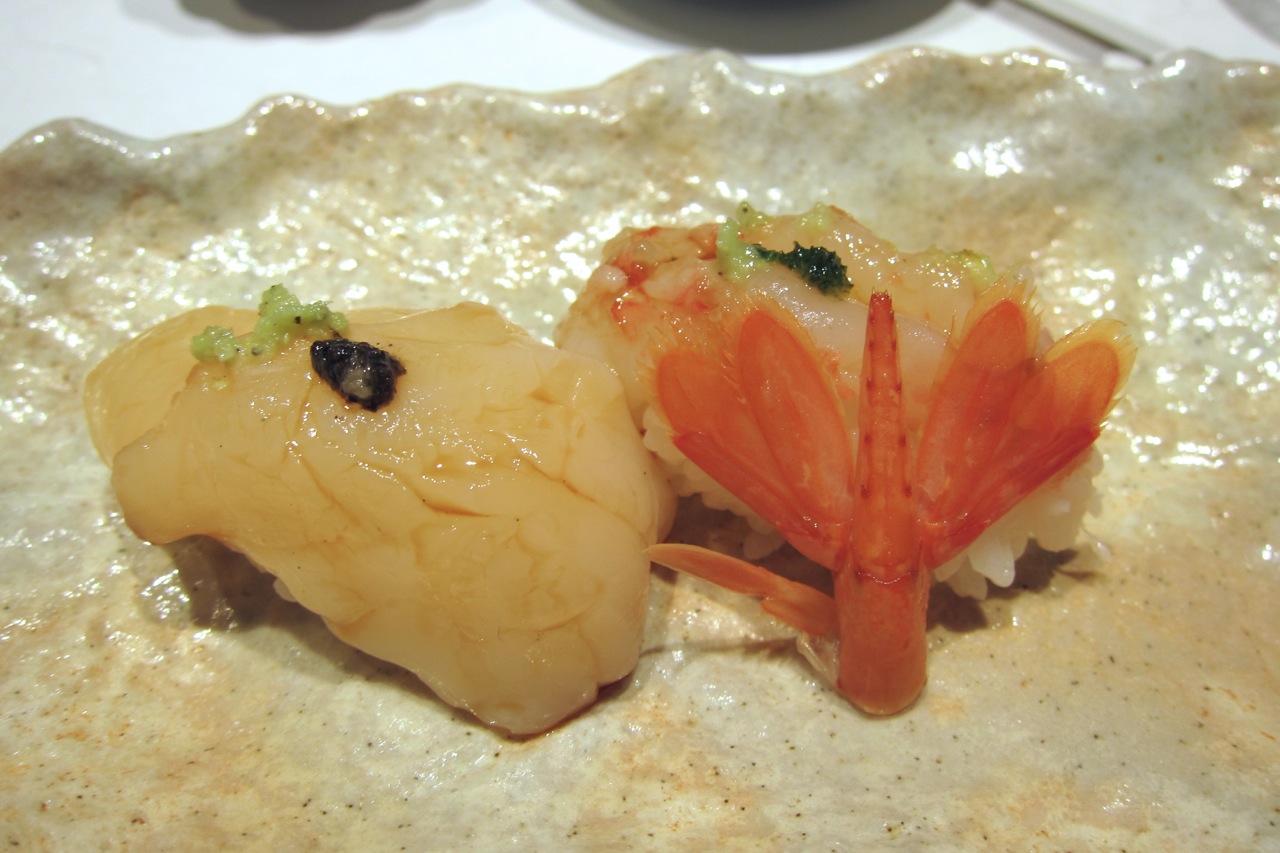
More nigri - Japanese scallop with black truffle, Crystal Bay prawn with shiso leaf paste and lightly seared squid with ginger 
Yuzu sorbet - deliciously refreshing
And the second time in June - 

The long menu! 
Japanese kamiage yuba with wasabi and seaweed
Potato somen noodles with grated ginger, ginger shoot, spring onion and oscietra caviar 
Clear soup with red mullet, okura (a sticky leaf in a star shape) and that entertainingly crazy watershield again
Sashimi, clockwise from top left - a type of clam, lobster, sea bream, seared squid,  a seared fish I can't remember and mackerel
Lemon sole kawari-age - deep fried in a delicate rice cracker crumb batter
Slow simmered aubergine with peas and diced duck breast - the aubergine tasted rich and savoury thanks to its meaty sauce, and retained its structure despite being meltingly soft
Palate cleansing baby peach jelly 
Nigri sushi - fatty tuna with wasabi stem, yellow tail with spring onion and a white fish I forget...
More nigri - excellent scallop with wasabi and black truffle and sweet shrimp similarly dressed
And finally - rare, red beef fillet nigri - bloody delicious 
Tomewan - simmered crab soup
I am already looking forward to our next visit.

The Shiori 
45 Moscow Road
London W2 4AH
Tel: 020 7221 9790

Tuesday, 18 June 2013

Oriental Dragon

From the outside, this little restaurant looks just like its casual Chinese neighbours - there is no design-led interior, brand consultancy styled menu or PR hype. There isn't even a website. There is your standard Cantonese menu with its roll call of salt and pepper squid, crispy seaweed, prawn toasts and so on. But there is also another menu, accompanied by photographs, with a range of regional dishes that one would never have found offered in the past.

Here you will find Sichuan specialities, full of chilli fire and numbing spice, Shandong dishes which emphasise seafood and more adventurous Cantonese classics like jellyfish and duck tongues. Much loved noodle dishes from Taiwan and Beijing make an appearance, as do charred cumin spiked skewers from Xinjiang and there is plenty of offal, whether sizzling hot or garlicky cool.

This is amazing. It is exciting to see regional Chinese cuisine becoming so commonplace in London that the need for new restaurants to shout about it appears to have passed. It is simply part of what is expected now in the London food scene. Regional Chinese cuisine has arrived, it is not a fad, it is here to stay. And that makes me very happy indeed.

We enjoyed a very good dinner. Despite over ordering on such a grand scale that our table became a source of amusement for our waiters, the three of us managed to ensure that there wasn't even a sliver of tongue left for me to take home in a doggy box. While this is not supposed to be refined cuisine, there was a skilled level of knife-work evident, along with excellent wok control - nothing was greasy. Contrasting flavours were well balanced and married with vibrant, distinctive sauces. There are many more dishes I would like to go back and try.

Here's what we had:
Sliced cucumber and jellyfish salad. I love jellyfish. I love how the translucent, elastic-like bands suggest rubbery texture but snap between your teeth after a little bounce and then crunch. I love the pairing of slippery jellyfish with shards of vinegar-softened cucumber and nuggets of garlic. This refreshing mouthful will awaken your palate, cool fiery tastebuds and give you breath that will knock a vampire dead at sixty paces.  
Undoubtably the star of dinner because this was the best razor clam dish I have ever tasted. The clams were beautifully sliced and perfectly cooked to form delicate curls lightly slicked with sauce. These were combined with crunchy wood ear mushrooms, crisp green peppers, sliced spring onions and fresh and dried chillies that delivered varying levels of heat from mild and fresh to deep and smoky. The whole plate was additively moreish and sparkled with bright flavours and different textures.  
Tofu with preserved egg and spring onion. This dish has been praised by critics recently and is definitely delicious but it is so easy to prepare it is hard for me to see it as worthy of praise for the chef's skill. All you need is silken tofu (the ones in the refrigerated cabinets are best), century eggs and spring onions from a Chinese supermarket - slice, chop and arrange then dress with soy sauce with a bit of sugar, chilli oil and a little sesame oil. That is pretty much it. Delicious yes, but other dishes were much more impressive.  
Pork lungs in chilli sauce. The Chinese on the menu identified this dish by its more familiar name - man and wife offal slices. This is one of my favourite Sichuan dishes of all time, traditionally made from slices of spiced beef offal such as heart, tongues and stomach dressed with soy sauce, chilli oil and numbing Sichuan peppers, garnished with toasted peanuts, Chinese celery, spring onions and sesame. Whether this was a similar version with just pork offal or a mix of pork and beef I cannot be sure, but it was the same winning combination of soft spiced meat and fiercely flavoured dressing that I adore. 
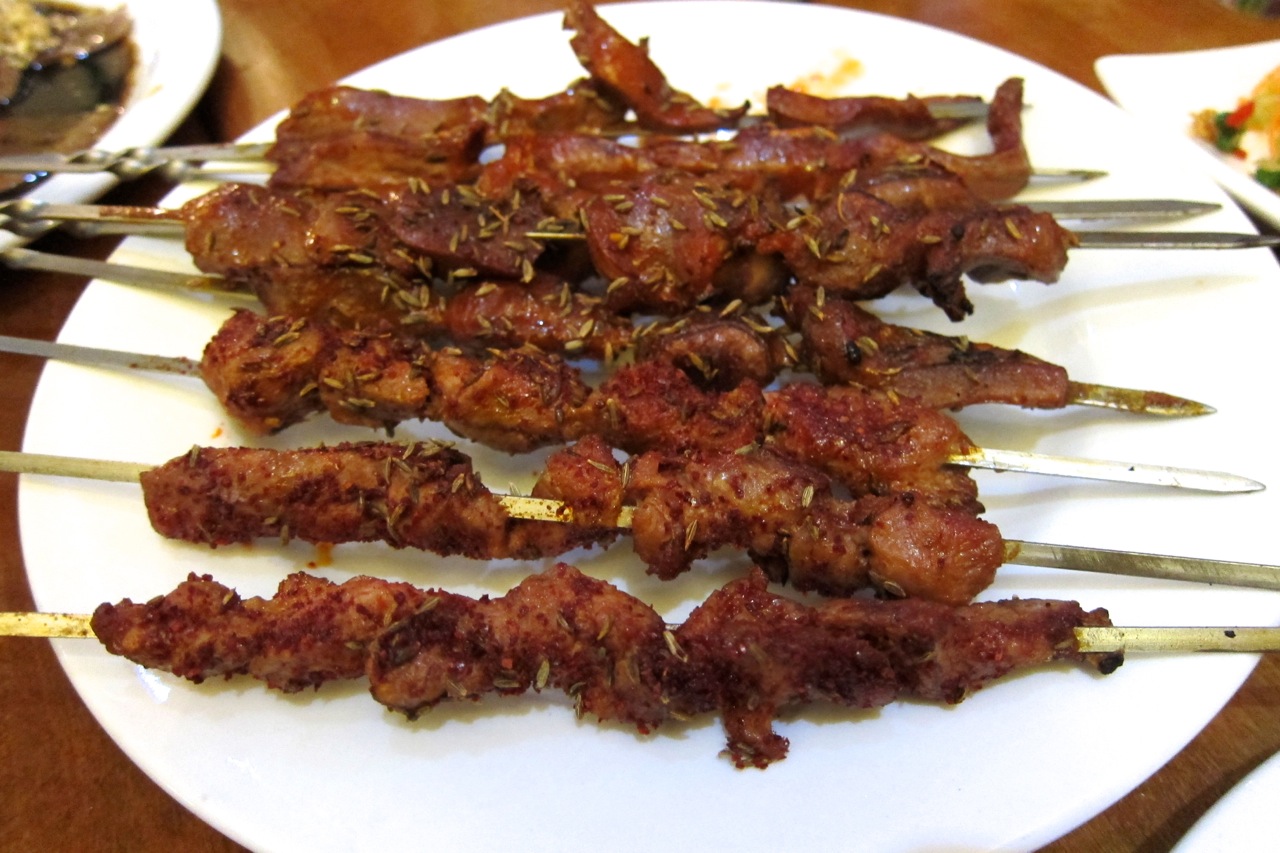
Chinese traditional BBQ skewers - cumin studded beef, bouncy chicken gizzards and tender pig's kidney, charred and intensely tasty.
Steamed spiced pig tongue with garlic and soy sauce. Soft slices of tongue accompanied by a healthy amount of chopped garlic made milder by marinading in the light and dark soy sauces used to dress the dish.
Stir fried sliced pig stomach with hot pepper. We expected slices of pig tripe that were fiery hot with chilli and were surprised to be served a dish with no heat at all and slices of tripe so elegantly cut they resembled oyster mushrooms. Even more delightful was the discovery that these lightly sauced, tender meaty leaves had no trace of offaly funk whatsoever, just a wonderfully soft texture and lovely, delicate flavour.
We also had braised aubergine in brown sauce, stir fried Chinese pea sprouts with garlic and salt and pepper deep fried squid. What a feast.

The bill, with a brilliant lack of any itemisation!